Welcome to www.nice-sharing.blogspot.com

This blog present to you by www.romescopurba.com

This is default featured post 2 title

Go to Blogger edit html and find these sentences.Now replace these sentences with your own descriptions.

This is default featured post 3 title

Go to Blogger edit html and find these sentences.Now replace these sentences with your own descriptions.

This is default featured post 4 title

Go to Blogger edit html and find these sentences.Now replace these sentences with your own descriptions.

This is default featured post 5 title

Go to Blogger edit html and find these sentences.Now replace these sentences with your own descriptions.

Sunday, July 24, 2011

History, Origin And Structure Of Batak Script

The Batak script, called locally surat Batak, is an abugida used to write the Austronesian Batak languages spoken by several million people on the Indonesian island of Sumatra.

History

In most Batak communities, only the priests, or datu were able to use the Batak script, and used it mainly for magical texts and calendars. After the arrival of Europeans in the Batak lands, first German missionaries and, from 1878 onwards, the Dutch, the Batak script was, alongside the Roman script, taught in the schools, and teaching and religious materials were printed in the Batak script.

Soon after the first World War the missionaries decided to discontinue printing books in the Batak script, not only for financial reasons but also because generally the Batak preferred using the Roman script[citation needed]. The script soon fell out of use and is now only used for ornamental purposes.


Origin

The Batak script was probably derived from Pallava and Old Kawi alphabets, which ultimately were derived from the Brahmi alphabet, the root of almost all the Indic and Southeast Asian abugidas.

Structure

Batak is written from up to down within one line, and left to right for lines. Like most abugidas, each consonant has an inherent vowel of /a/, unless there is a diacritic (in Toba Batak called pangolat) to indicate the lack of a vowel. Other vowels, final ŋ, and final velar fricative [x] are indicated by diacritics, which appear above, below, or after the letter. For example, ba is written ba (one letter); bi is written ba.i (i follows the consonant); bang is written baŋ (ŋ is above the consonant); and bing is baŋ.i. Final consonants are written with the pangolat (here represented by "#"): bam is ba.ma.#.


However, bim is written ba.ma.i.#: the first diacritic belongs to the first consonant, and the second belongs to the second consonant, but both are written at the end of the entire syllable. Unlike most Brahmi-based scripts, Batak does not form consonant conjuncts.

Saturday, July 23, 2011

List of Batak Tribe That Has Success

Academician


Pantur Silaban, physicists
Williater Sitorus, Geologist
Taruna Sinaga, Chemist
Parulian Silaen PhD, Accounting Lecturer in Australia.

Architect

Arsitek Silaban, Architect
Jimmy Purba, Architect

Athletes

Radja Nainggolan, football player
Saktiawan Sinaga, football player
Mahyadi Panggabean, football player


Attorneys

Ruhut Sitompul
Hotman Paris Hutapea
Tommy Sihotang
Luhut Pakpahan
Mochtar Pakpahan
Todung Mulya Lubis
Adnan Buyung Nasution
Junifer Girsang
Ruhut Sitompul
Hotma Sitompul


Authors

Sitor Situmorang
Bonggas L. Tobing


Economist

Miranda Goeltom, Deputy Senior Bank of Indonesia (BI)
Darmin Nasution, Deputy Senior Bank of Indonesia
Arifin Siregar, Deputy Bank of Indonesia
Aulia Pohan, Deputy Bank of Indonesia
Pande Radja Silalahi, executive from CSIS


Chocky Sitohang
Entertainers

Bill Saragih, jazz musician
Choky Sitohang, host
Joy Destiny Tobing, singer
Nadya Hutagalung, actress
Zivanna Letisha Siregar, model
Daan Lansink/Siregar, Local Drummer


Military

Abdul Haris Nasution, former commander of Indonesian army forces
Donald Izacus Panjaitan, Indonesian revolutionary hero
Maraden Panggabean, former Indonesian government minister


TB Silalahi
Politician

Adam Malik, former Indonesian vice president
Akbar Tanjung, former head of Golkar party
Amir Sjarifuddin, former Indonesian prime minister
Burhanuddin Harahap, former Indonesian prime minister
Malam Sambat Kaban, Indonesian government minister
Raja Inal Siregar, former North Sumatera Province Governor
T.B. Silalahi, former Indonesian Military General


Reporter
Putra Nababan

Mochtar Lubis, founder of Horizon magazine
Sondang Sirait, Voice of America Reporter
Rosiana Silalahi, famous Indonesian Reporter, Chief of Liputan 6
Putra Nababan, famous Indonesian Reporter, Chief of Seputar Indonesia

Business People

DL Sitorus
Hiras Purba, founder of Purba Ticketing
D. L. Sitorus, Founder of Torganda
Taha Tobing, Founder of SEREWare
David Simamora, Founder of Belebas

Islam And Other influences In Land Of Batak

Islam

Abdul Haris Nasution, General of the Indonesian Army
The Mandailing and Angkola people, occupying the southern Batak lands, came under the influence of the neighbouring Islamic Minangkabau people as a result of the Padri War (1821–1837).[42] Tens of thousands of Mandailing were forcibly converted to Islam, repudiating their traditional Batak faith.

Some Mandailing had previously converted to Islam, but the Padri war was a watershed event, with the Padri Wahabbis suppressing traditional adat and promoting 'pure' Islamic faith.

Over time Mandailing Islam, has been brought closer to the predominant Southeastern Shafi`i school of Islam as a result of Mandailing discourse with other Islamic practitioners and the practice of hajj, although traditional elements remain, such as dividing inheritance among all children, a Mandailing rather than Islamic practice.

Islam caused the decline in importance of marga, with many Mandailing abandoning their marga in favour of Muslim names, much less so among the Angkola to their North.
Abdul Haris Nasution, General of the Indonesian Army


The advent of Islam also caused the relegation of the datuk to a medicine man, with traditional rice-planting ceremonies and other such remnants of traditional culture deemed incompatbile with Islam.

The 'pasusur begu', a ceremony invoking ancestors to aid the community, was also suppressed. Other aspects of adat were however tolerated, with the Mandailing Islamic ideology placing adat on the same level as Islamic law, as in contrast with the Minang practice of placing Islamic law above adat. In more recent times, learned Islamic scholars (ulama) studying abroad, have suggested that many traditional Mandailing practices, such as the 'Raja' hereditary leaders, were in conflict with Islam, being indicative of 'pele begu'.

The Islamist ulama were in conflict for authority with the Namora-Natora, the traditional village legal practitioners, who were influenced by adat as much as Islam.

Christian missionaries had been active among the northern Mandailing from 1834 onwards, but their progress was restricted by the Dutch government, who feared conflict between newly converted Christians and Muslims. In addition, the lingua franca of the government was Malay, associated with Muslims, as were government civil servants, creating the perception that Islam was the religion of modernity and progress.

Missionaries determined that resistance among the Muslim Mandailing to Christianity was strong, and the missionaries abandoned them as 'unreachable people', moving north to evangelize the Toba.

At the turn of the 20th century, nearly all Mandailing and Angkola were Muslims. Despite this, the Dutch administration them as part of the Bataklanden, and therefore heathen or Christian. This perception was an inaccurate one, and many Mandailing strongly rejected the 'Batak' label.

Abdullah Lubis, writing in the 1920s, claimed that while the Mandailing followed Batak marga practice, they had never followed the Batak religion, and that the Mandailing people pre-dated the Toba, having acquired marga directly from 'Hindu' visitors. In the Dutch census, the Mandailing objected strongly to being listed in the census as 'Batak Mandailing'.


Mandailing in Malaysia (who migrated in the years following the Padri war), had no such objection to their being deemed 'Malays', and indeed Malaysian Mandailing retain little of their distinct identity, partly due to a British colonial policy of rice-land ownership restrictions for all but Malay-speaking Muslims, and the disapproval of 'Batak' Muslim practices by the existing Malay Muslim population.

Other influences

Modern Batak people are subject to religious influences through marriage and migration. Formerly Christian villages may, through migration of Muslim outsiders, lose their explicitly Christian identity, with pork excluded from wedding feasts in favour of meats acceptable to Islam.

Abrahamic religions

Christianity
At the time of Marco Polo's visit in 1292 the people were described as "wild idolaters" who had not been influenced by outside religions, however by Ibn Battuta's visit in 1345 Arab traders had established river-ports along the northern coasts of Sumatra and Sultan Al-Malik Al-Dhahir had recently converted to Islam.


Sir Stamford Raffles perceived the Batak lands as a buffer between the Islamic Aceh and Minang kingdoms, and encouraged Christian missionary work to preserve this. This policy was continued by the Dutch, who deemed the non-Muslim lands the 'Bataklanden'.

In 1824 two British Baptist missionaries, Richard Burton and Nathaniel Ward, set off on foot from Sibolga and traveled through the Batak lands. After three days' journey they reached the high valley of Silindung and spent about two weeks in the Batak region. Considering the shortness of their stay their account reveals very intensive first-hand observation.

This was followed in 1834 by Henry Lyman and Samuel Munson from the American Board of Commissioners for Foreign Missions who met with a more hostile reception. According to Ida Pfeiffer:

"Some time before the arrival of the missionaries some Mohammedan priests had made their appearance in the country, accompanied by a band of armed men, and had forced them by fire and sword to accept their religion...When, therefore, the unfortunate Americans presented themselves as religious teachers, the Battakers imagined they were going to have a repetition of the same scenes, and resolving to be beforehand with their tormentors, they killed them and ate them up."


Herman Neubronner van der Tuuk was employed by the Nederlands Bijbel Genootschap (Netherlands Bible Society) in the 1850s to produce a Batak-Dutch grammar-book and a dictionary, which enabled future Dutch and German missionaries to undertake the conversion of the Toba and Simalungan Batak.

The first German missionaries to the Lake Toba region arrived in 1861, and a mission was established in 1881 by Dr. Ludwig Ingwer Nommensen of the German Rhenish Missionary Society. The New Testament was first translated into Toba Batak by Dr. Nommensen in 1869 and a translation of the Old Testament was completed by P. H. Johannsen in 1891.

The complete text was printed in Latin script in Medan in 1893, although H. O. Voorma describes the translation as “not easy to read, it is rigid and not fluent, and sounds strange to the Batak…[with] a number of errors in the translation.” 

The Toba and Karo Bataks accepted Christianity rapidly and by the early 20th century it had become part of their cultural identity.

This period was characterized by the arrival of Dutch colonists and while most Bataks did not oppose the Dutch, the Toba Batak fought a guerrilla war that lasted into the early 20th century and ended only with the death in 1907 of their charismatic priest-warrior-king Si Singamangaraja XII, who had battled the Dutch during the First Toba War with both magic and weaponry.

Batak churches
HKBP Church in Balige, North Sumatra, built ca. 1917/WIKIPEDIA
The Huria Kristen Batak Protestan (HKBP) Church was established in Balige in September, 1917. By the late 1920s a nursing school was training nurse midwives there. In 1941, the Gereja Batak Karo Protestan (GBKP) was established. Although missionaries ceded much power to Batak converts in the first decades of the 20th century, Bataks never pressured the missionaries to leave and only took control of church activities as a result of thousands of foreign missionaries being interned or forced to leave after the 1942 invasion of Sumatra by the Japanese.


The Gereja Kristen Protestan Simalungun, originally part of the HKBP and preaching in Batak Toba language, eventually became a distinctively Simalungun church, adopting Simalungun customs and language, before finally incorporating as GKPS in 1963.

Traditional Batak medicine

In traditional Batak society datuk (animist priests) as well as gurus practiced traditional medicine, although the former were exclusively male. Both professions were attributed with supernatural powers and the ability to predict the future.

Treatments and healing rituals bear some resemblance to those practiced by dukuns in other parts of Indonesia. Following the Christianization of the Toba and Karo Batak in the late 19th century, missionaries discouraged traditional healing and divination and they became largely clandestine activities.

Both datuk and guru healers also practiced divination by consulting a pustaha, a handwritten book made of wood and bark in which were inscribed recipes for healing remedies, incantations and songs, predictive calendars, and other notes on magic, healing and divination written in poda, an archaic Batak shorthand. According to Winkler, there were three categories of Pustaha based on the purpose of their usage:

1. Protective Magic, which includes diagnosis, therapy, medicinal mixes which have magical properties, such as amulets, parmanisan (love charms), etc.
2. Destructive Magic, which encompasses the art of making poison, the art of controlling or utilizing the power of certain spirits, calling the pangulubalang, and the art of making dorma (magical formulas for causing a person to fall in love).
3. Divination, which involves oracles (words of the gods), the wishes of the spirits, commands from the gods and from the spirits of the ancestors, and an almanac or calendrical system (porhalaan), and astrology to determine auspicious days and months to accomplish certain actions or goals.

The datu or guru consulted the pustaha when presented with a difficult problem, and in time this became in itself a ritual. When missionaries began to discourage traditional healing and augury the Bible may have been adopted by some gurus in place of the pustaha.

Among the most important healing ceremonies performed in Toba and Karo communities is that of recalling the jinujung, or personal guardian spirit. According to Toba and Karo cosmology, each person receives a jinujung in childhood or at puberty and they keep it for life unless they are unfortunate enough to lose it, in which case they will fall ill. In order to call the jinujung back, a female guru (guru sibaso in Karo) goes into a trance and the jinujung will enter into her and speak through her mouth. At this time the sick person or the family can negotiate ritual payment to entice it to return.

Traditional healers are not powerful enough to cure illness due to the loss of a person's tendi (this falls under the jurisdiction of the datuk), however they do play a role in communicating with begu and influencing their behavior.


Malim
Main article: Parmalim

Malim is the modern form of the Batak Toba religion. Practitioners of Malim are called Parmalim. Non-Malim Batak peoples (those following Christian or Muslim faith) often continue to believe certain aspects of traditional Batak spiritual belief.


The 'Perodak-odak' movement among the Karo people in the 1960s was a reassertion of the traditional Karo religion, but has largely faded; a subsequent Karo movement to identify as Hindu was noted starting from the late 1970s in order to adopt, if only in name, one of the recognised religions of Indonesia, while in practice still following traditional beliefs.

Traditional Batak religion

Batak tugu on the island of Samosir, Lake Toba, December 1984/WIKIPEDIA
The various Batak cultures differ in their pre-colonial religious ideas as they do in many other aspects of culture. Information about the old religious ideas of the Mandailing and Angkola in southern Batakland is incomplete, and very little is known about the religion of the Pakpak and Simalungun Batak.

For the Toba and Karo on the other hand the evidence in the writings of missionaries and colonial administrators is relatively abundant. Information on the traditional forms of Batak religion is derived mainly from the writings of German and Dutch missionaries who became increasingly concerned with Batak beliefs towards the end of the 19th century.

Various influences affected the Batak through their contact with Tamil and Javanese traders and settlers in southern Batakland, and the east and west coast near Barus and Tapanuli, in particular the large Padang Lawas temple complex in Tapanuli.

These contacts took place many centuries ago and it is impossible to reconstruct just how far the religious ideas of these foreigners were adopted and reworked by the Batak. It is suggested that the Bataks adopted aspects of these religions, specifically Mahayana Buddhist, Shaivist, and Tantrist practices within their own customs.


The modern Indonesian state is founded on the principles of pancasila, which requires the belief in 'one and only God', the practice of either Protestantism, Catholicism, Islam, Buddhism or Hinduism, one of which must be entered on an individual's KTP.

Traditional religions are not officially recognised, and accordingly traditional religions are increasingly marginalised, although aspects of the traditional Batak religion are still practised alongside Christianity, and, to a lesser extent, Islam.

Creation myths

There are many different versions in circulation. These were formerly passed down through oral tradition but have now been written down in the local languages. There are also large collections of Batak tales collected by European scholars since the mid-19th century and recorded in European languages, mostly Dutch.

At the beginning of time there was only the sky with a great sea beneath it. In the sky lived the gods and the sea was the home of a mighty underworld dragon Naga Padoha. The earth did not yet exist and human beings, too, were as yet unknown.


All the surviving myths record that at the beginning of creation stands the god Mula Jadi Na Bolon. His origin remains uncertain. A rough translation of the name is the "beginning of becoming". The creation of everything that exists can be traced back to him. Mula Jadi lives in the upper world which is usually thought of as divided into seven levels. His three sons, Batara Guru, Mangalabulan and Soripada were born from eggs laid by a hen fertilized by Mula Jadi.

Two swallows act as messengers and helpers to Mula Jadi in his act of creation. Their functions vary in the different versions. Mula Jadi begets three daughters whom he gives as wives for his three sons. Mankind is the result of the union of the three couples. Besides the three sons of Mula Jadi there is another god, Asiasi, whose place and function in the world of the gods remains largely unclear. There is some evidence that Asiasi can be seen as the balance and unity of the trinity of gods.

The ruler of the underworld, i. e. the primeval sea, is the serpent-dragon Naga Padoha. He too existed before the beginning and seems to be the opponent of Mula Jadi. As ruler of the underworld Naga Padoha also has an important function in the creation of the earth.

What all the six gods so far mentioned have in common is that they play a minor role in ritual. They do not receive any sacrificial offerings from the faithful and no places of sacrifice are built for them. They are merely called on in prayers for help and assistance.

The origin of the earth and of mankind is connected mainly with the daughter of Batara Guru, Sideak Parujar, who is the actual creator of the earth. She flees from her intended husband, the lizard-shaped son of Mangalabulan, and lets herself down on a spun thread from the sky to the middle world which at that time was still just a watery waste. She refuses to go back but feels very unhappy.

Out of compassion Mula Jadi sends his granddaughter a handful of earth so that she can find somewhere to live. Sideak Parudjar was ordered to spread out this earth and thus the earth became broad and long. But the goddess was not able to enjoy her rest for long.

The earth had been spread out on the head of Naga Padoha, the dragon of the underworld who lived in the water. He groaned under the weight and attempted to get rid of it by rolling around. The earth was softened by water and threatened to be utterly destroyed.

With the help of Mula Jadi and by her own cunning Sideak Parudjar was able to overcome the dragon. She thrust a sword into the body of Naga Padoha up to the hilt and laid him in an iron block. Whenever Naga Padoha twists in the fetters an earthquake occurs.

After the lizard-shaped son of Mangalabulan, the husband the gods intended for her, had taken another name and another form, Sideak Parujar marries him. Sideak Parujar becomes the mother of twins of different sexes.

When the two have grown up their divine parents return to the upper world leaving the couple behind on the earth. Mankind is the result of their incestuous union. The couple settle on Pusuk Buhit, a volcano on the western shore of Lake Toba, and found the village of Si Anjur Mulamula. The mythological ancestor of the Batak, Si Raja Batak is one of their grandchildren.

The tendi cult

In the religious world of the Toba and Karo Batak the gods and the creation of mankind are far less significant than the complex concepts connected with the tendi (Karo) or tondi (Toba) and the begu. Probably the most useful translations of these terms are "life-soul" and "death-soul". A person receives his "life-soul" (tendi) from Mula Jadi Na Bolon before he is born.

The destiny of the individual tendi is decided by the tendi itself before birth. Various myths are woven around manner in which the tendi choose their destiny from Mula Jadi. Warneck, a missionary and for a long time superintendent (ephorus) of the Batak Church, recorded two particularly expressive myths in his major work on Batak religion. What is significant is that the tendi themselves are responsible for their destiny:

"Mula Jadi presents him with all kinds of things to choose from. If the tendi asks for ripe pepper, then the person whom he animates will be a poor fellow; if he asks for flowers, then he will live only a short time; if he asks for a hen, the person will be restless; rags indicate poverty; an old mat, lack of fame; a gold piece, wealth; plate, spear, medicine pot indicate that he will become a great chief or understand magic arts."

"With Mula Jadi in the upper world is a mighty tree called Djambubarus. Mula Jadi has written on all its leaves. On one leaf is written 'many children', on others 'wealth' or 'respect' and so on. 'Contemptible life', 'poverty', 'wretchedness' are also written on the leaves.

All the possible different fates of the person are entered on the leaves. Every tendi that wishes to descend to the middle world must first ask Mula Jadi for one of the leaves. Whatever is written on the leaf chosen by him will be his destiny in the middle world."

Among the Karo and the Toba there are sometimes widely diverging versions of where the tendi dwells and how many tendi there are. According to the Toba a person has seven tendi. The second tendi is found in the placenta and amniotic fluid of the new-born baby, and accordingly the afterbirth is given special attention after the birth of a child.

It is usually buried under the house, is called saudara (brother) and is regarded as the person's guardian spirit. Similar ideas about the afterbirth are also found among the Karo, who also bury the placenta and amniotic fluid under the house and regard them as two guardian spirits (kaka and agi) who always remain close to the person.

All Batak regard the loss of tendi as signifying a great danger for "body and soul". Tendi can be separated from their owners through inattentiveness, or as a result of black magic by a datu with evil intentions. In other words, the tendi is not tied to the body; it can also live for a time outside the body.

The final loss of the tendi inevitably results in death. There are a variety of ideas about where exactly in the body the tendi dwells. It is present to a particularly high degree in certain parts of the body, especially the blood, the liver, the head and the heart.

Sweat too is described as rich in tendi. It is believed that illnesses are connected with the absence of tendi, and the bringing back of the tendi is a main method of healing.

The Karo, for instance, have gifts, called upah tendi (upah = wage, payment, gift), which they give to their tendi so that their tendi stay with them. These gifts may consist of a knife, a gong, a particular piece of clothing, a water buffalo or a small holy place. The gifts are carefully cared for in order to keep the tendi satisfied.

Tendi love the sound of the surdam (a bamboo flute). If a tendi has abandoned the body of a patient, the playing of the surdam in the raleng tendi ritual can contribute to the tendi returning to the body of the sick person.


It must be emphasized that only the datuk are in a position to interpret and influence people's tendi correctly. If their endeavors are unsuccessful, then clearly the tendi has chosen another destiny for itself.

Death cult
Batak Totem Pole

At death the tendi leaves the human body through the fontanelle and the "death-soul" (begu) is set free. It is thought that the tendi vanishes and after the death of any human being only the begu continues to exist.

The Batak believe that the begu continue to live near their previous dwelling (in a village of the dead which is thought to be situated not far from the cemetery) and that they may contact their descendants. Bad dreams, particular misfortune and such like may be signs that the begu of an ancestor is not satisfied with the behavior of its descendants.

Any individual can attempt to pacify an enraged begu by means of food and drink offerings and prayers. If this does not work, a datu or a guru must be called in. The begu are not immortal, since death also rules in the land of the dead: a begu dies seven times before it is changed into a straw and finally becomes earth.

The Batak believe that three categories of begu exist. The bicara guru are the begu of stillborn babies or of babies who have died before teething. It is possible to turn bicara guru into guardian spirits if misfortune has befallen the family of the child shortly after its death.

With the help of a guru sibaso, the bicara guru can be made the family's guardian spirit for which a shrine is provided and to which sacrifices are regularly made. Once a year the bicara guru is accorded a special feast, preceded by ritual hair washing.

The begu of members of the family who have had a sudden death (mate sada-uari) can also act as guardian spirits for the family. They include the victims of accidents, suicides, murder victims, or people struck by lightning.

A shrine is built where they are venerated and where sacrifices are made. A third category consists of the begu of dead virgins (tungkup). Their graves, called bata-bata or ingan tungkup, are maintained for a long time by their relatives.
Burial traditions

Batak burial traditions are very rich and complex. Immediately after death various ritual actions are performed to make the begu understand that from now on its world is separate from that of its kin. Symbolically this is done by reversing the mat on which the corpse is laid out so that the body lies with its head at the foot of the mat.

Thumbs and toes respectively are tied together and the body is rubbed all over with camphor and its orifices stopped with camphor, then it is wrapped in a white cotton cloth. During this perumah begu ceremony a guru sibaso declares to the begu of the deceased that it is definitely dead and must take leave of its relatives.

Wealthier families have their coffins (Karo: pelangkah) made of the wood of the kemiri tree (Ateurites rnoluccana), carved in the shape of a boat, its bow decorated with the carved head of a hornbill, or a horse, or a mythical beast known as a singa.

The lid is then sealed with resin and the coffin may be placed in a special location near the family's house until a reburial ceremony can take place (see below). Families that are not wealthy use simple wooden coffins or wrap the body in a straw mat.

The corpse is carried a few times round the house, usually by women, and then to the cemetery with musical accompaniment from the gondang orchestra and the continual firing of guns. At any crossroads the corpse is put down and eleven people go around it four times to confuse the begu. It is hoped that the begu will then be unable to find its way back to the village.

When the funeral procession arrives at the cemetery the grave is dug and the corpse laid in it, flat on its back. Care is taken that the head lies towards the village so that, in the unexpected event that the body should get up, he or she will not be looking in the direction of the village.

The bodies of datuk and those who have died from lightning are buried sitting up with their hands tied together. The palms of the hand are tied together and betel placed between them.
Reburial


The burial tradition includes a reburial ceremony in which the bones of one's ancestors are reinterred several years after death.

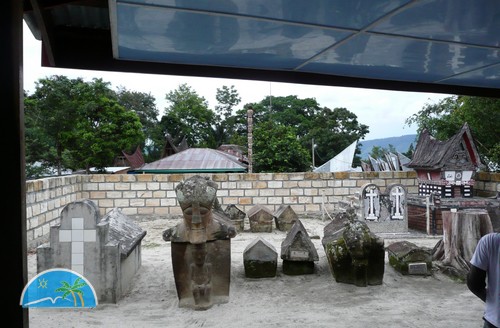
This secondary burial is known among the Toba Batak as mangongkal holi, among the Karo as nurun-nurun. In a ceremony lasting several days the bones of a particularly honored ancestor and those of his descendants are exhumed, cleaned, mourned and finally laid to rest again in a bone house known as a tugu or tambak:

"On the morning of the first day of the festival the graves in the cemetery are opened and the bones of the ancestors that are still there are removed. The unearthing of the skulls is presented as especially moving. The bones are collected in baskets lined with white cloth and then ritually cleaned by the women using the juice of various citrus fruits.

The exhumation and cleaning of the bones is accompanied by the singing of laments. The bones are kept in the baskets in the tugu until the next morning, when the remains are wrapped in traditional cloths (ulos) and transferred from the baskets to small wooden coffins.

After long speeches and a communal prayer the coffins are nailed down and placed in the chambers of the tugu. A feast consisting of meat and rice follows and traditional dances are performed"

In ancient times these sarcophagi were carved from stone or constructed from wood and later brick. Nowadays they are made of cement or concrete. Large and very ornate tugu can be seen around Lake Toba and on the island of Samosir.
Batak tugu on the island of Samosir, Lake Toba, December 1984.

One motive for the reburial ceremony appears to be to raise the status of the begu of the deceased. Traditional Batak beliefs hold that the dead occupy a hierarchical status similar to the social position they held in life.

This means that a rich and powerful individual remains influential after death, and this status can be elevated if the family holds a reburial ceremony. A rich descendant can advance a begu to the status of a sumangot by means of a great ceremony and a horja feast which can last up to seven days. In antiquity a vast number of pigs, cattle or even buffalo were slaughtered at such festivals, and the gondang orchestra provided an accompaniment.

The next level up from the sumangot is the sombaon, who are the spirits of important ancestors who lived ten to twelve generations ago. To raise a sumangot to a sombaon requires another great festival, a santi rea, often lasting several months, during which the inhabitants of the whole district come together. These powerful ancestor spirits offer protection and good fortune to their descendants, but the ceremony also serves to establish new kinship groups descended from the ancestor thus honored.
Geography

The regencies of North Sumatra, coloured where they have a majority Batak population. The Karo lands extent significantly to the north and east of the area coloured on the map, almost to Medan. Borders with the Minang and Acehnese are noted
source: wikipedia

Location ethnic groups of Sumatra, the Batak tribes located around Lake Toba in North Sumatra

The Batak lands consist of North Sumatra province, excluding Nias island and the historically Malay kingdoms of the East coast. In addition, part of the Karo lands extend into modern-day East Aceh Regency in Aceh province, while parts of the Mandailing lands lie in Rokan Hulu Regency in Riau. Significant numbers of Batak have migrated in recent years to prosperous neighbouring Riau province.


To the south of North Sumatra are the Muslim Minangkabau of West Sumatra, while to the north there are various Muslim Acehnese peoples.

Ritual cannibalism

Source: Wikipedia: Judgement Place of Toba Batak
Ritual cannibalism is well documented among Batak people, performed in order to strengthen the eater's tendi. In particular, the blood, heart, palms and soles of the feet were seen as rich in tendi.

In Marco Polo’s memoirs of his stay on the east coast of Sumatra (then called Java Minor) from April to September of 1292, he mentions an encounter with hill folk whom he refers to as “man-eaters”. From secondary sources, Marco Polo recorded stories of ritual cannibalism among the "Battas".

Marco Polo's stay was restricted to the coastal areas, and he never ventured inland to directly verify such claims. Despite never personally witnessing these events, he was nonetheless willing to pass on descriptions which were provided to him, in which a condemned man was eaten:

"They suffocate him. And when he is dead they have him cooked, and gather together all the dead man's kin, and eat him. And I assure you they do suck the very bones till not a particle of marrow remains in them...And so they eat him up stump and rump.

And when they have thus eaten him they collect his bones and put them in fine chests, and carry them away, and place them in caverns among the mountains where no beast nor other creature can get at them. And you must know also that if they take prisoner a man of another country, and he cannot pay a ransom in coin, they kill him and eat him straightway.

The Venetian Niccolò de' Conti (1395–1469) spent most of 1421 in Sumatra in the course of a long trading journey to Southeast Asia (1414–1439), and wrote a brief description of the inhabitants: "In a part of the island called Batech live cannibals who wage continual war on their neighbors.".
Judgement Place of Toba Batak
Batak warriors, 1870.
Source: wikipedia/Batak warriors, 1870.

Sir Thomas Stamford Raffles in the 1820s studied the Batak and their rituals and laws regarding the consumption of human flesh, writing in detail about the transgressions that warranted such an act as well as their methods. Raffles stated that "It is usual for the people to eat their parents when too old to work," and that for certain crimes a criminal would be eaten alive: “The flesh is eaten raw or grilled, with lime, salt and a little rice.”.


The German physician and geographer Franz Wilhelm Junghuhn visited the Batak lands in 1840-41. Junghuhn says about cannibalism among the Batak (whom he called "Battaer"):

“People do the honest Battaer an injustice when it is said that they sell human flesh in the markets, and that they slaughter their old people as soon as they are unfit for work...They eat human flesh only in wartime, when they are enraged, and in a few legal instances.”

Junghuhn tells how after a perilous and hungry flight he arrived in a friendly village, and the food that was offered by his hosts was the flesh of two prisoners who had been slaughtered the day before,however he maintains that the Batak exaggerated their love of human flesh in order to frighten off would-be invaders and to gain occasional employment as mercenaries for the coastal tribes who were plagued by pirates .

Oscar von Kessel visited Silindung in the 1840s and in 1844 was probably the first European to observe a Batak cannibalistic ritual in which a convicted adulterer was eaten alive.

Interestingly, his description parallels that of Marsden in some important respects, however von Kessel states that cannibalism was regarded by the Batak as a judicial act and its application was restricted to very narrowly defined infringements of the law including theft, adultery, spying or treason. Salt, red pepper and lemons had to be provided by the relatives of the victim as a sign that they accepted the verdict of the community and were not thinking of revenge.


Ida Laura Pfeiffer visited the Batak in August 1852 and although she did not observe any cannibalism, she was told that:

"Prisoners of war are tied to a tree and beheaded at once; but the blood is carefully preserved for drinking, and sometimes made into a kind of pudding with boiled rice. The body is then distributed; the ears, the nose, and the soles of the feet are the exclusive property of the Rajah, who has besides a claim on other portions.

The palms of the hands, the soles of the feet, the flesh of the head, and the heart and liver, are reckoned peculiar delicacies, and the flesh in general is roasted and eaten with salt. The Regents assured me, with a certain air of relish, that it was very good food, and that they had not the least objection to eat it. The women are not allowed to take part in these grand public dinners."

Dutch and German missionaries to the Batak in the late 19th century observed a few instances of cannibalism and wrote lurid descriptions to their home parishes in order to raise donations. The growing Dutch influence in northern Sumatra led to increased Malay influence in coastal trade and plantations, pushing the Karo farther inland. Growing ethnics tensions culminated in the 1872 Karo Rebellion where the Karo were suppressed by Dutch and Malay forces.


Despite this, Karo resistance to Dutch imperialism lingered into the early twentieth century.  In 1890 the Dutch colonial government banned cannibalism in the regions under their control.[18] Rumors of Batak cannibalism survived into the early 20th century but it seems probable that the custom was rare after 1816, due partially to the influence of Islam.

Batak's Society

Karonese People/Source: wikipedia
Batak societies are patriarchally organized along clans known as Marga. A traditional belief among the Toba Batak is that they originate from one ancestor "Si Raja Batak", with all Margas, descended from him.

A family tree that defines the father-son relationship among Batak people is called tarombo.

In contemporary Indonesia, Batak people have a strong focus on education and a prominent position within the professions, particularly as teachers, engineers, doctors and lawyers.

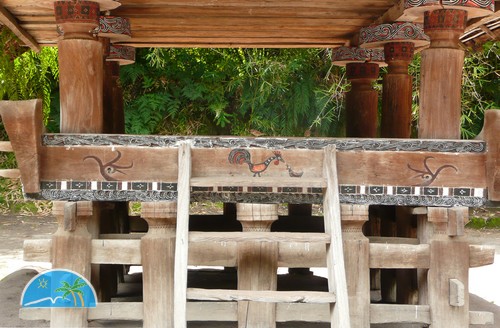
Toba Batak are known traditionally for their weaving, wood carving and especially ornate stone tombs.


Before they became subjects of the colonial Dutch East Indies government, the Batak had a reputation for being fierce warriors. Today the Batak are mostly Christian with a Muslim minority. Presently the largest Christian congregation in Indonesia is the HKBP (Huria Kristen Batak Protestan) Christian church.

The dominant Christian theology was brought by Lutheran German missionaries in the 19th century, including the well-known missionary Ludwig Ingwer Nommensen. Christianity was introduced to the Karo by Dutch Calvinist missionaries and their largest church is the GBKP (Gereja Batak Karo Protestan).


The Mandailing and Angkola Batak were converted to Islam in the early 19th century. A significant minority of Batak people do not adhere to either Christianity or Islam, however, and follow traditional practices known as the agama si dekah, the old religion, which is also called perbegu or pemena.

Batak's Language

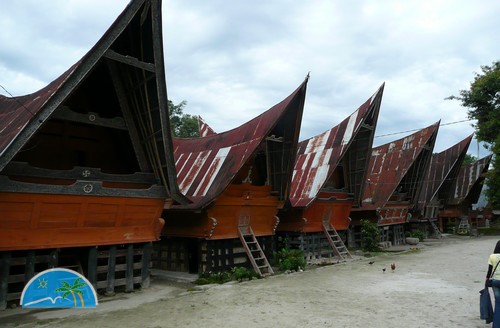
Batak House: source wikipedia
Batak speak a variety of closely related languages, all members of the Austronesian language family. There are two major branches, a northern branch comprising the Pakpak-Dairi, Alas-Kluet and Karo languages that are similar to each other but distinctly different from the languages of the southern branch comprising three mutually intelligible dialects: Toba, Angkola and Mandailing. Simalungun is an early offspring of the southern branch. Some Simalungun dialects can be understood by speakers of Batak Karo whereas other dialects of Simalungun can be understood by speakers of Toba. This is due to the existence of a linguistic continuum that often blurs the lines between the Batak dialects.


The Batak possess their own script known as the Surat Batak. The writing has chiefly ceremonial importance within traditional religious ceremonies, and was subject to little change for this reason. It is likely that the Batak people received their writing system from southern Sumatra.

Prehistory

A Karo Batak woman in traditional clothes
Linguistic and archeological evidence indicates that Austronesian speakers first reached Sumatra from Taiwan and the Philippines through Borneo and/or Java about 2,500 years ago, and the Batak probably evolved from these settlers. While the archaeology of southern Sumatra testifies the existence of neolithic settlers it seems that the northern part of Sumatra was settled by agriculturalists at a considerably later stage.
A Karo Batak woman in traditional clothes

Although the Batak are often considered to be isolated peoples, largely because they were inland, away by seafaring European colonials, there is evidence that they have been involved with trade and contact with other neighbouring kingdoms for a millennium or more. The 'Bata' were possibly documented in Zhao Rugua's 'Description of the Barbarous People', which refers to a 'Ba-ta' dependency of Srivijaya. The Suma Oriental, of the 15th century, refers to the kingdom of Bata, bounded by Pasai and Aru. Due to the absence of Europeans in the region century prior to the 19th century, reliable historical records of the Batak before 1800 are almost non-existent.

The Bataks were likely involved with trade with Srivijaya for benzoin and camphor, both of which were important commodities for trade with China, and grew in the Batak lands of Northwest Sumatra, perhaps from the eighth or ninth centuries, and continuing for the next thousand years, Batak men carrying the products on their backs for sale at ports.

It is suggested that the important port of Barus, in Tapanuli was populated primarily by Batak people. A Tamil inscription has been found in Barus dated 1088, while contact with Chinese and Tamil traders took place at Kota Cina, established in the eleventh century, and comprising 10,000 people by the twelfth century. Tamil remains have been found on key trade routes to the Batak lands.

These trading opportunities may have caused migration of Batak from Pakpak and Toba to the current day Karo and Simalungun 'frontier' lands, where they were exposed to greater influence from visiting Tamil traders, while the migration of Batak to the Angkola-Mandailing lands may have been prompted by eight-century Srivijayan demand for camphor.


The Karo marga 'Sembiring', meaning 'black one' is believed to originate from their ties with Tamil traders, with specific Sembiring sub-marga, namely Brahmana, Colia, Pandia, Depari, Meliala, Muham, Pelawi, and Tekan all of Indian origin. Tamil influence on Karo religious practices are also noted, with the pekualuh secondary cremation ritual specific to the Karo and Dairi people.


From the sixteenth century onwards, Aceh increased the production of pepper, an important export commodity, and in doing so needed to import rice, which grew well on the Batak wetlands. Batak people in different areas cultivated either 'sawah' (wet ricefields) or 'ladang' (dry rice), and Toba Batak, most expert in agriculture, would have migrated to meet demand in new areas. The increasing importance of rice had religious significance, increasing the power of the Batak high priests, who had responsibility for ensuring agricultural success.

BATAK (INDONESIA)

Batak is a collective term used to identify a number of ethnic groups predominantly found in North Sumatra, Indonesia. The term is used to include the Toba, Karo, Pakpak, Simalungun, Angkola and Mandailing, each of which are distinct but related groups with distinct, albeit related, languages and customs (adat). Occasionally it is also used to include the Alas people of Central/Southern Aceh, but usually only as relates to language groups.

In North Sumatra, Toba people typically assert their identity as 'Batak', while other 'Bataks' may explicitly reject that label, preferring instead to identify as specifically 'Simalungun', 'Karo', etc

Samosir Island

Source: Wikipedia
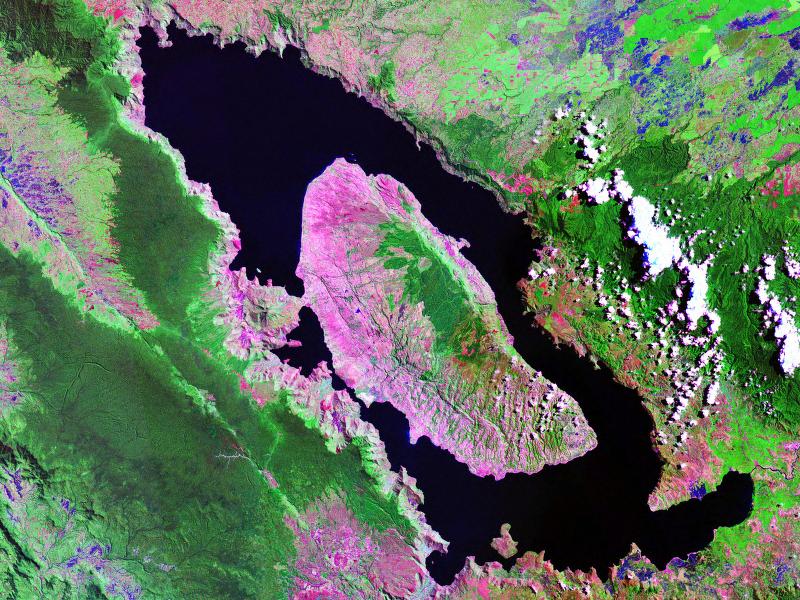
Samosir, or Samosir Island, is a large volcanic island in Lake Toba, located in the north of the island of Sumatra in Indonesia. Administratively, Samosir Island is governed as six of the nine districts within Samosir Regency. The lake and island were formed after the eruption of a super volcano some 75,000 years ago. The island was originally connected to the surrounding caldera wall by a small isthmus, which was cut through to aid navigation.
Source: NASA
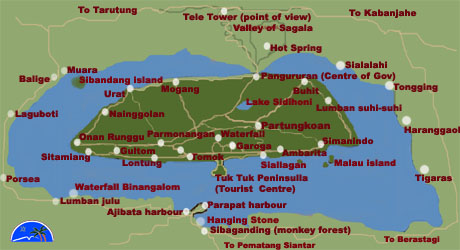
At 630 km², Samosir is the largest island within an island, and the fifth largest lake island in the world. It also contains two smaller lakes, Lake Sidihoni and Lake Aek Natonang. Across the lake on the east from the island lies Uluan Peninsula. The island is linked to the mainland of Sumatra on its western part by a narrow land connecting the town of Pangururan on Samosir and Tele on mainland Sumatra. Tele consequently offers one of the best views of Lake Toba and Samosir Island.

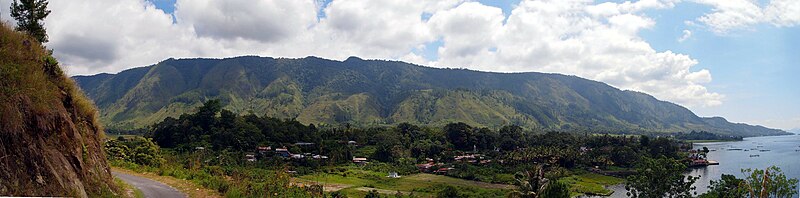
Panoramic view of the town of Ambarita on Samosir, Lake Toba
Tourism

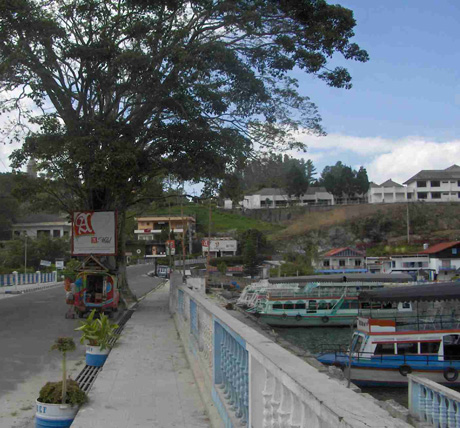
Samosir is a popular tourist destination due to its exotic history and the vistas it offers. The tourist resorts are concentrated in the Tuktuk area. The island is the centre of the Batak culture and many of this people's artifacts remain on the island. Most of the tourist accommodations are concentrated in the small town of Tuktuk, which is located a one-hour ferry ride across the lake from the town of Parapat.


Samosir Regency is a regency in North Sumatra. Its seat is Pangururan. In 2000, the regency covered an area of 1419 square kilometres and according to the 2000 census it had a population of 130,097.

6 of 9 districts (kecamatan), are on the island Samosir.

Samosir Island districts
Onan Runggu
Palipi
Pangururan
Ronggur Nihuta
Simanindo
Sitiotio

Mainland districts
Harian
Sianjur Mula Mula
Nainggolan

Botanical Garden

2011: Samosir Regency with supervision from LIPI will build a 100 hectares Botanical Garden. It will finish 10 years later with cost predicted about Rp.73 billion ($8.6 million)

Samosir Island Maps
Source: samosirtourism.com

Friday, July 22, 2011

Public Transportation To Lake Toba


Public Transportation Boat is important transportation of people around Lake Toba. The boat various and dimention but all of them were made from logs.
Boat
Net

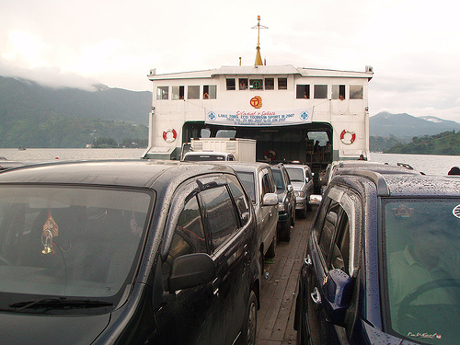
Ferry is used to transport car, motorcycles or others to and from Samosir Island - Parapat.
Boat
Net

Fruit trees galagala sirumondang ni bulan


Galagala is a type of tree that has fruit garnish. Mate digalagala, = mate di holangholang, died on the battlefield as a spectator (because it should not be rewarded revenge his death). Galagala is a kind of therapeutic material is swollen, but we have is not knowing the resources which parts of the tree this galagala becoming the drugs. Fruit Galagala one source of animal fodder trees, monkeys (bodat).
galagala
Galagala trees can we find around Tuktuk Samosir Island. Galagala the raw fruit is also believed the Batak people as an upset stomach. The smell, sour taste of fruit galagala if us apart. Name galagala also be called a village, such as Huta Galagala direction Huta Balige. Source: gobatak.com

Simarjarunjung mountain, The other side views of Lake Toba

flickr.com
Visit Huta – Simalungun, Located 49 km from Pematang Siantar or 123 km from Medan via Berastagi and can be reached by public transport. A good road conditions. But this time we passed the road is not so good, many roads are not paved and hollow.

Our journey together Novels Simbolon, Ranie Agustina Haloho, and Audi Tambunan Hasian riding a motorcycle towards Dolok Simarjarunjung.

Simarjarunjung, a mountainous area on the shores of Lake Toba, a climate / cold fresh. This is an ideal tourist destination and many domestic and international tourists visit this place.


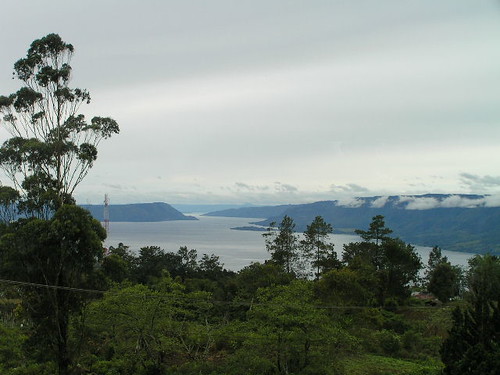
From the top Simarjarunjung we can see the beautiful panorama around Lake Toba, especially when the sun rises in the morning. Simarjarunjung located in the middle of the road between Parapat toward Sipiso Piso waterfall.

Beautiful scenery when we were on top Dolok Simarjarunjung, and there are TVRI owned national television broadcasting relay stations, which broadcast the event TVRI (national television broadcasting of the Republic of Indonesia) is beloved to all regions in North Sumatra.


And also adjacent to the telecommunications tower owned by Telkom Indonesia. If our attention from building assets owned national television broadcasting station has been quite apprehensive TVRI alias no longer maintained. Unlike the telecommunication towers from Telkom Indonesia is quite different, clean and friendly. Source: gobatak.com

Video:

Gulamo – Salt fish (ikan asin) remains a favorite

source:gobatak.com
Gulamo – fish sauce is a food meat fish is preserved by the addition of large quantities of salt. With this method of preservation, that often rotten meat fish in a short time can be stored at room temperature for a period of many months, although normally must be closed very well. Salted fish remains a favorite of all societies, salted fish Kampong is proud of food are served.


Various kinds of fish tend to be marinated, both on land and marine fish fishes. These fish were collected in a container and then sprinkled with or engaged in a concentrated salt solution. The big fish are often split or cut in advance so that the salt are filtered with ease in the flesh. For the Batak, fish salting – Gulamo a typical menu that you can forget.
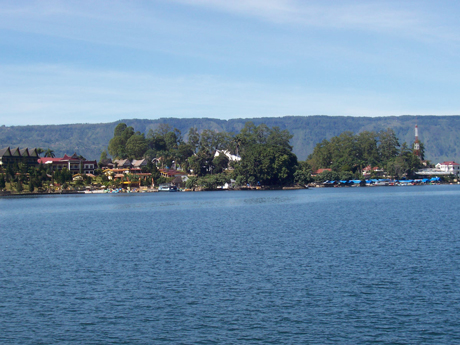
Simarjarunjung The other side views of Lake Toba

source:gobatak.com
Novels Simbolon, Ranie Agustina Haloho, and Audi Tambunan Hasian with Team Gobatak down the street from Dolok Simarjarunjung into three bronze. Along the left side of the road seems very beautiful scenery made us pause to enjoy the beautiful sight of Lake Toba. God’s creation is truly breathtaking view of human nature creations, really fun.

Observing nature is so beautiful and cool weather makes us feel happy and at ease to enjoy the beauty of nature. Views of verdant hills, steep valleys, panoramic beauty of Lake Toba is blue, can not escape the eye when entering the area of Lake Toba.


Lake Toba was inhabited by the seven districts that cultural background, language, traditions are almost the same. Each time the eye could see, Lake Toba was always able to at least give the meaning of beauty. This is the natural grace of the Lord of the painting. Actually this is a pearl. It’s just our ignorance as if it makes him miserable.

Lake Toba was formed from the eruption of a volcano. Peak of the mountain collapsed and there was Lake Toba. Some wreckage was become Samosir Island. Make the region’s natural event to be beautiful. Lake area of 6.60 square kilometers surrounded by the walls of the towering hills to 480 feet above sea level.


So what are you waiting, let’s go to Lake Toba and safe holiday.

Menu Foods, Sirara Aili (Rendang)

Rendang aili meat (wild boar) that is cooked with coconut milk and spices. Meat used is fresh meat, meat is not preserved. Seasoning and cooking in the same way with the kitchen rendang in general. We only use a Aili meat.
soure:gobatak.com
Method:
1. soak meat with spice paste at least a hour.
2. Cook in the skillet over coconut milk medium, stirring occasionally until the fleet at the surface (at least 20 minutes) coconut oil and book
3. In a large pan, meat insert with coconut milk and spices up to 300 cc (until black meat)
4. Enter leaves of laurel and lemon leaves of grass, and simmer medium while stirring, stirring until half of coconut milk evaporates


5. Pour 100 cc of coconut milk and stir in the coconut milk until the water evaporates
6. Keep stirring and add remaining coconut milk approximately 100 cc to all castings.
7 Cook until the meat becomes sensitive (at least half time 1st) and until all the water evaporates in the coconut milk and spices rendang as well.

Good luck.

Gomak Noodles Breakfast Menu Version Tradiosional Batak

Gomak Noodles, Breakfast Menu Version Tradiosional Batak
Net

Material:
1. 250 gr stick noodles
2. 500 gr chicken breast

3. 100 gr chicken claw
4. 250 gr squash, julienne slices along
5. 5 large chilies
6. 10 pieces of red chili, plucked stalks, leave intact
7. 5 onions
8. 5 cloves garlic
9. 3 stalk green onion, thinly sliced
10. 5 stalk lemongrass, crushed
11. 6 kaffir lime leaves
12. 3 plum tomatoes, split lengthwise 6
13. ½ grated coconut old half lengthwise, make serundeng. Finely minced
14. 1250 ml water
15. 4 tablespoons cooking oil


How to Make:

1. Rinse chicken breasts boiled and reserving broth in 1250 ml. After cold-Suwir Suwir meat re-enter into the broth. Set aside
2. Large red chilli finely milled, garlic and shallots.
3. Soak the noodles stick in warm boiled water, until soft.
4. Heat oil, saute ground spices, enter the lemongrass, lime leaves, and cook until fragrant.
5. Enter a stir spices to the stew broth, bring to a boil again.
6. Enter your squash and tomatoes. Cook until boiling.
7. Shortly before the appointed cayenne enter intact.
8. Presentation: Take a stick noodles from the marinade, add to the bowl. Pour the soup broth, sprinkle with scallion, finely serundeng, and lime juice. Serve while hot.

The characters sound similar to one Artist Batak

His name Pahala Pakapahan who have similar sound character with one Artists Batak. One week ago with Wanson Sinaga and Posan Sinaga gathered in Sopo Gobatak while singing along.

In the following video, sing a few songs Batak Pahala Pakpahan like “Unang Djaishon” and also the Western Songs (Oldies). Pahala Pakpahan who lived in Pematangsiantar able to sing with a voice that is high enough. He talked about his experience in the field of sound art since high school, “I do not drink alcohol and not smoking” he said.

For the first time the friends who came to Sopo Gobatak singing happy hear sing Pahala Pakpahan. Good luck to Pakpahan Pahala, you have the talent for singing. Success always.


Source

Video recipe: Menu Sunday afternoon with daun ubi tumbuk

This video is about the steps how to cook daun ubi tumbuk by the Gobatak team. Like I’ve posted about the recipe above can be viewed at this link (How to Make Cooking Recipes Daun Ubi Tumbuk). The result of this recording using Sony DSC W310 with QVGA sets.


Arsik Recipe From Emlichheim, Germany

Arsik Recipe From Emlichheim, Germany byRika van der Meijde

Difficult to find some ingredients that are usually used for Arsik in my town,such as gold fish,long beans,onion hobo,galangal. So I have maked arsik with very simple ingredients ,but the taste also delicious, almost same with original Arsik.
Ingredients :
1. 700 Gr Tilapia fish
2. 1 big red onion
3. Green beans
4. leek
5. Salt to taste
6. Water 150 ml
7. 2 tsp Andalimans
8. 3 Red Paper
9. 6 candle nut
10. 2 turmeric
11. 1 Lime juice
12. 3 small lemongrass


How to create :
1. Marinate the fish with lime juice, let stand for 30 minutes, and drain.
2. Smooth onion,andalimans,candle nut ,turmeric with stone mill but can also with blender.
3. Prepare the pan with water,insert the fish and all ingredients include green beans,leek, turmeric and salt to taste.
4. Simmer until cooked fish and seasoning to absorb.

Why Must Visit Samosir Island?

Beautifully panorama and natural
Samosir, or Pulau Samosir, is a large volcanic island in Lake Toba.

The natural beauty of Lake Toba, fresh air and the lake's blue water and fresh.
The island is the centre of the Batak culture and many of this people's artifacts remain on the island.


Related Posts Plugin for WordPress, Blogger...

Romescopurba.com News Feed 2.0 RSS

Twitter Delicious Facebook Digg Stumbleupon Favorites More